Systems assessment
Inventory business applications, dependencies, ownership and recurring pain points.

Review your systems, access, working practices and operational risks. Consulting produces a practical improvement roadmap; support scope defines what is covered, who owns each system and how requests are handled.
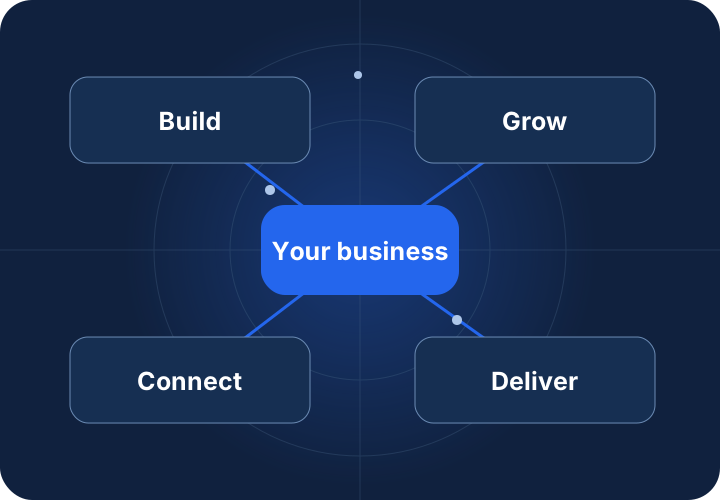
The following workstreams inform your proposal. The agreed deliverable list defines what is included; they are not an automatic package bundle.
Inventory business applications, dependencies, ownership and recurring pain points.
Prioritize compatibility, maintainability, access governance and operational continuity.
Define covered systems, request channels, response expectations and escalation responsibilities.
Document approved changes, test where possible and plan rollback and user guidance.
Workflow illustration. Application connections and automation are verified separately before activation.
Access, compatibility, provider terms and acceptance testing determine what can be connected. No new subscription is assumed.
Review goals, users, content, data and system access. Agree a dated milestone plan after discovery. Complexity, dependencies and review turnaround determine the schedule; no unverified fixed delivery time is promised.
Receive a proposal with deliverables, exclusions, responsibilities and acceptance criteria. Provider fees, licenses, media spend and ongoing support are separated where applicable.
Compare Launch, Grow, Scale & custom scope ↗Review on an isolated environment, test the agreed scenarios and approve the release separately. Handover, maintenance hours, response expectations and change requests are defined in the support agreement.
Questions specific to IT Consulting & Support.
No 24/7 coverage or response SLA is assumed. Support hours and escalation expectations must be explicitly agreed.
Access is limited to the approved task, systems and roles. Credentials should be shared through approved secure channels.
Assessment and implementation can be separate phases. The proposal distinguishes recommendations from changes.
A general IT review is not a compliance certification. Specialized audit requirements need a defined scope and qualified assessment.
Backup responsibilities, retention, restore tests and incident procedures are documented with the system owner.
Existing tools are preferred. Any additional subscription or hardware requires an itemized cost and approval.
The support agreement defines contact, triage and escalation. No response guarantee is implied before that agreement.
Task-focused training and documentation can be scoped for agreed systems and roles.
Tell us where you are today. We’ll help you plan what comes next.